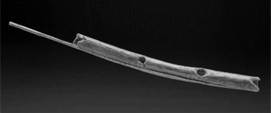
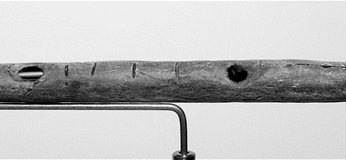
Aurignacian archaeological culture, made in between 43,000 and 35,000 years ago of mammoth ivory:
The development of the flute in Western art music reflects a transition from simple end-blown and transverse instruments of antiquity to the more refined Baroque transverse flute (traverso).
By the seventeenth and early eighteenth centuries, the traverso—typically made of wood and consisting of a conical bore with a single key—had become established across Europe, particularly in France and Germany. Its expressive capabilities were closely aligned with vocal aesthetics, favouring subtle dynamic nuance and articulation over sheer volume.
Composers such as Johann Joachim Quantz, who also authored an important performance treatise, and Johann Sebastian Bach contributed significantly to its repertoire, exploiting its lyrical qualities in both chamber and orchestral contexts. Despite its limitations in chromatic facility and projection, the Baroque flute occupied an important role as both a solo and obbligato instrument.
The nineteenth century brought transformative changes with the development of the modern flute, most notably through the work of Theobald Boehm. Boehm’s redesign introduced a cylindrical bore, an advanced key system, and metal construction, resulting in greater technical agility, improved intonation, and increased dynamic range. These innovations enabled the flute to meet the demands of expanding orchestras and virtuosic repertoire.
Composers such as Claude Debussy and Maurice Ravel exploited its new tonal possibilities, particularly in orchestral colour and impressionistic textures, while the twentieth century saw further expansion through extended techniques and new repertoire by figures including Edgard Varèse. As a result, the flute has evolved into a highly versatile instrument, capable of both technical brilliance and refined expressive subtlety across a wide range of musical styles.

